

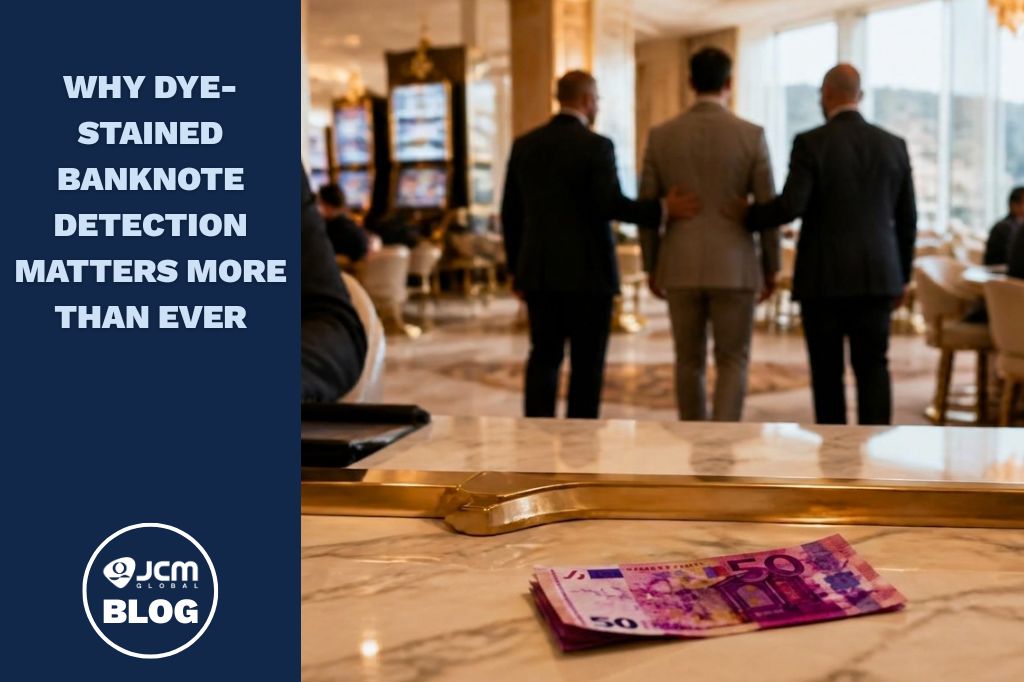
A Single Banknote Can Cost Far More Than Its Face Value
Every day, businesses across the gaming, retail and self-service sectors process thousands of cash transactions. Most banknotes pass through without attracting attention, but occasionally one tells a very different story. A banknote marked by security dye may originate from an attack on an ATM, cash cassette or cash-in-transit container. When such a note is accepted, the operator may lose its full value and face additional administrative work, internal investigations and contact with banks or the relevant authorities. Detecting compromised banknotes is therefore no longer only a concern for banks. It is an important part of protecting modern cash-handling operations.
Why Are Banknotes Dye-Stained?
Many banks and cash-in-transit operators use Intelligent Banknote Neutralisation Systems, commonly known as IBNS, to protect cash against theft. When an attack is detected, the system releases permanent security ink onto the banknotes inside the protected container. This makes the stolen cash easier to identify and more difficult to return to circulation. The European Central Bank advises people not to accept ink-stained banknotes because the staining may indicate that the notes originate from a criminal act. Intentionally damaged euro banknotes are generally not replaced, although the final assessment depends on the circumstances and the applicable national procedures. Despite these protections, dye-stained banknotes can still be presented at gaming machines, kiosks, retail checkouts and other automated payment points.
The challenge for operators is clear:
How can a compromised banknote be identified before the machine accepts it?
Traditional Banknote Validation Has Its Limits
Banknote validators are designed to identify denominations and assess security characteristics. However, not every validation system examines the complete surface of the banknote in the same level of detail. This matters because dye contamination does not always appear as one obvious, uniform stain. Its colour, position and intensity may vary. Some traces may be subtle, particularly when a banknote has been cleaned, altered or mixed with legitimate cash. Modern cash-handling environments therefore require more than basic denomination recognition. Operators need validation technology capable of examining the full banknote and identifying abnormalities that conventional sensor arrangements may overlook.
The Cost Goes Beyond the Banknote
Accepting a dye-stained banknote can create consequences beyond the loss of its face value. The operator may need to remove the note from circulation, document what happened and clarify the situation with its bank, cash-handling partner or the relevant authorities. Staff may also need to review the transaction and determine where and when the banknote was accepted. For casinos and other cash-intensive businesses, reliable detection also contributes to a stronger overall security environment. A location known for robust cash controls is a less attractive target for attempts to introduce suspicious or compromised banknotes. Visible and reliable security measures can discourage repeat attempts while strengthening confidence among employees, customers and business partners.
Rejecting dye-stained banknotes can therefore help operators:
How UBA Ultra Helps
JCM’s UBA Ultra has been engineered for today’s evolving cash handling environment. Its advanced Contact Image Sensor (CIS) technology captures a high-resolution 200 DPI image of every banknote, analysing more than 25 million data points during each transaction. This detailed full-note imaging allows UBA Ultra to detect characteristics that conventional sensor technologies may overlook—including permanent security dye associated with IBNS-protected banknotes.
Combined with features such as:
UBA Ultra provides operators with greater confidence in every cash transaction.
Staying One Step Ahead
Criminal methods continue to evolve, and cash-validation technology must evolve with them. By capturing and analysing the complete banknote image, UBA Ultra helps operators identify dye-stained notes before they enter the cash box and become the operator’s problem. A single compromised banknote may appear insignificant. But when it results in financial loss, administrative work and a potential security investigation, its true cost can be far greater than the value printed on it. That is why reliable dye-stained banknote detection matters more than ever.
 Deutsch
 Español