

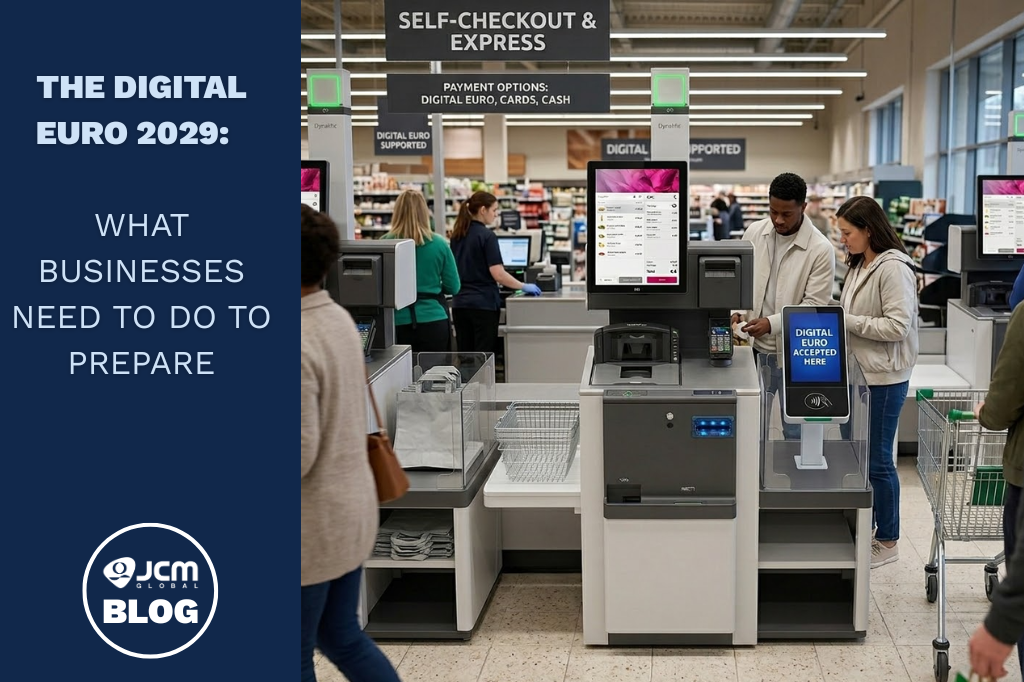
The Digital Euro is no longer a distant concept but is steadily moving towards reality.
With the European Central Bank (ECB) now working towards a potential launch in 2029, and a pilot phase expected to begin in 2027, the conversation is shifting. This is no longer about if a Digital Euro will happen, but how businesses will need to adapt.
For many, it still feels abstract. But the implications are very real and touches everything from payment infrastructure and customer experience to compliance and operational resilience.
So, what should businesses be thinking about now?
From concept to implementation
The ECB’s intention is clear: to create a digital form of central bank money that can be used across the euro area for everyday payments – both online and in physical environments.
Unlike private digital payment methods, the Digital Euro would sit alongside cash as a public payment option, distributed via banks and payment service providers.
For retailers and self-service operators, this reinforces the need for payment environments that can seamlessly support both digital and cash transactions side-by-side.
Crucially, this is not just about adding another payment method. It represents a shift towards a more standardised, pan-European payment ecosystem, designed to reduce fragmentation and strengthen financial independence.
Acceptance may become the norm
One of the key considerations for businesses is whether accepting the Digital Euro will become expected – or even required.
The direction of policy suggests that widespread usability will be a priority. If the Digital Euro is positioned as a core public payment method, businesses may need to treat it in much the same way as cash or cards today.
That raises immediate questions:
Infrastructure will need to evolve
The introduction of the Digital Euro will place new demands on payment infrastructure.
The ECB is already working with European standards bodies to ensure interoperability and consistency across systems. For businesses, this means preparing for a future where payment systems must be:
This is particularly relevant for retailers and operators managing complex environments, where efficiency and reliability are critical.
Physical payment infrastructure will also play a critical role, particularly in self-service environments where payment acceptance hardware, recyclers and unattended systems must adapt to new transaction flows.
Offline payments change the equation
One of the more significant – and less discussed – features of the Digital Euro is the ambition for offline functionality.
In practical terms, this means payments could be made without a live internet connection, using a mobile device or card.
For businesses, this introduces new considerations:
It also brings opportunities, particularly in environments where connectivity is inconsistent or where resilience is a priority.
Part of a much bigger shift
The Digital Euro is not arriving in isolation.
It sits within a broader transformation of the payments landscape, including:
It also reflects a strategic goal: reducing reliance on non-European payment providers and strengthening regional control over financial infrastructure.
For businesses, this means the digital euro is just one part of a wider move towards more digital, connected and regulated payment ecosystems.
What businesses should do now
While 2029 may seem some way off, the preparation window is already open.
A pilot phase is expected from 2027, and market participants are already being brought into early testing and development.
Businesses should be thinking about:
Those who prepare early will be better placed to adapt smoothly, rather than react under pressure later.
From theory to reality
The Digital Euro marks a significant step in the evolution of payments.
It won’t replace cash, and it won’t transform the market overnight. But it will introduce new expectations, new systems and new ways of thinking about money in a digital environment.
For businesses, the key takeaway is simple: this is no longer a theoretical discussion but a practical one – and the time to start preparing is now.
 Deutsch
 Español